Surveillance state
An Officer and a SpyThe Surveillance state is presented not as a single all-seeing institution but as a widening network of military intelligence, police agents, informants, postal interception, and documentary control. Its reach extends beyond suspected spies to their relatives and private correspondence. The novel’s central tension is that surveillance promises certainty through accumulation, yet the collected material can remain hearsay, mistaken inference, or evidence of a different person’s actions.
Intelligence Networks and Their Methods
The system begins with the French Army’s Statistical Section and its cooperation with agents and informants. Major Henry explains that an agent known by the code name Auguste supplies a product called the usual route, and the narrator’s questions about the agent show his effort to understand the service from its sources upward. Intelligence is not simply discovered: it is obtained through human intermediaries, assigned code names, and passed along a chain of command.
Police agent François Guénée is one such intermediary. He reports on the Dreyfus family under instructions from Colonel Sandherr, and his briefings turn private lives into operational material. The surveillance does not end with Alfred Dreyfus’s conviction. The stated rationale is that Colonel Sandherr suspected Dreyfus might belong to a wider spying network, so watching his relatives might reveal other traitors. That possibility makes the family itself an object of continuing investigation, though the suspicion is a theory rather than proof.
The methods described are deliberately practical and distributed. Agents keep watch; household employees and building staff report information; postal authorities divert communications so officials can make copies. Mathieu Dreyfus is followed, while informants include the concierge of his apartment building in the rue de Châteaudun, his wife’s maid, the family’s cook and the cook’s fiancé, and Madame Dreyfus’s nanny, who reports weekly. No single watcher needs to know everything. The effectiveness of the operation rests on combining small observations from people positioned inside ordinary domestic routines.
Family Surveillance and the Control of Correspondence
The monitoring of Alfred Dreyfus’s relatives reaches from observation into the management of communication. The narrator orders a full report on what the family is doing and asks to read all correspondence to and from Alfred Dreyfus on Devil’s Island. When Major Henry brings the letters, some are originals retained by the censor and others are copies of correspondence that was permitted to pass. Tied with black ribbon and bearing the official seal of the French Ministry of Colonies, the bundle makes censorship tangible: private words have become an official file, physically gathered and available for inspection.
The letters disclose a contrast the surveillance operation cannot erase. Alfred Dreyfus’s correspondence addresses Lucie Dreyfus and the children with intimate concern, while the military file treats their communications as potential evidence of assistance or coded messages. Lucie Dreyfus is prohibited from mentioning the case or related events. She must submit her letters to the French Ministry of Colonies by the twenty-fifth of each month, after which officials in that ministry and the Ministry of War copy and read them. Major Étienne Bazeries, chief of the cipher bureau in the French Ministry of Foreign Affairs, also checks them for possible encoded messages, as he does Alfred Dreyfus’s letters to Lucie. The first batch sent to Cayenne is returned to Paris for another examination; Alfred Dreyfus receives news from home only on 12 June, after a four-month silence.
This process turns correspondence into both a family connection and a monitored channel. The state does not merely intercept messages after they are sent; it restricts what may be written, reproduces what is received, and subjects the copies to specialist interpretation. The stated concern is hidden communication, but the consequence is that the emotional life of a prisoner and his family is routed through the same administrative machinery as suspected espionage.
Surveillance Beyond the Dreyfus Family
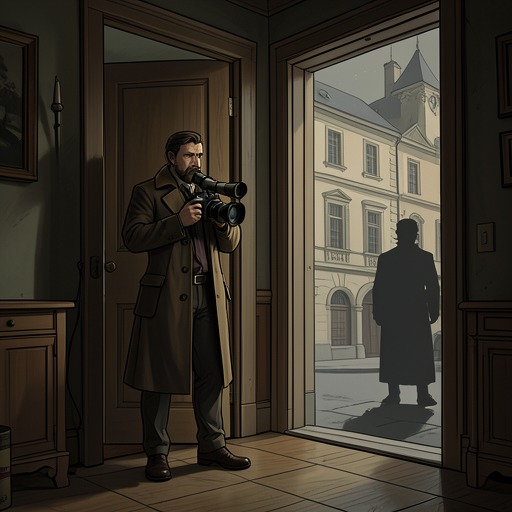
The novel also shows intelligence work directed outward, toward foreign diplomatic activity. Under the code name Operation Benefactor, the narrator arranges for Germain Ducasse to rent an apartment opposite the German Embassy in Paris, at 101 Rue de Lille, across from Hôtel de Beauharnais. The operation equips the apartment with optical and photographic equipment and darkroom chemicals. Desvernine, posing as Houdin, explains Ducasse’s work; the narrator later visits the stakeout himself in civilian clothes, with his hat brim lowered, and hears German voices from the flat below as he enters.
This operation has a different immediate object from the monitoring of the Dreyfus family, but it relies on the same logic: make a person, household, or institution observable by placing watchers and recording equipment nearby. The narrator’s own participation also reveals that surveillance is not just a policy announced by superiors. It requires money, rented space, cover identities, equipment, and careful separation between the observer and the operation. The watchers themselves must avoid becoming visible.
The network also depends on informants whose information may be incomplete. In a deposition Henry describes warnings from the Spanish military attaché, the marquis de Val Carlos, who said that a French officer on the General Staff was supplying information to German and Italian military attachés. The marquis could not name the officer. This report prompted more rigorous surveillance, but it did not identify a culprit. The gap between a credible warning and a provable identity is crucial: increased observation may follow suspicion without resolving it.
Files, Inference, and the Failure of Certainty
Surveillance produces files that can appear more conclusive than their contents. When the narrator opens the five documents in the secret file, he finds circumstantial claims about access, opportunity, and a suspected initial rather than a document or witness directly naming Alfred Dreyfus as a traitor. He questions whether the alleged removal of fortification plans was physically plausible and notices that the dates do not fit: the plans were reportedly in German hands before Dreyfus joined the First Department. The file’s accumulation of reports has not settled the question; it has given conjecture an official form.
The narrator’s later discovery in the intelligence archive exposes a still sharper failure of identification. Among the material associated with agent Auguste, he finds a note signed by Dubois offering the secret of smokeless powder, along with Henry’s earlier report on a suspected agent designated D. That report identifies Jacques Dubois, a printer, as a possible source of plans, then concludes that the plans he supplied were publicly available and recommends no further action. The narrator recognizes the consequence plainly: D is not Dreyfus but Dubois. A short initial, detached from its context and fed into a suspicious narrative, could seem to corroborate the accusation even though the archive contained information pointing elsewhere.
The scale of the secret file also makes secrecy fragile. When the narrator lists those who know of it, he counts ten senior or intelligence figures, then seven judges, President Fauré, the president’s doctor Gibert, and Mathieu Dreyfus as the man informed of its existence—twenty people before accounting for anyone to whom Mathieu may have spoken. His reflection that there is no such thing as a secret is grounded in this expanding chain of access and in the technologies that carry information through modern life. The file is guarded, but its circulation makes it vulnerable to disclosure.
Significance
The Surveillance state in the novel is powerful because it can follow people, divert their mail, copy private letters, and preserve fragments of information in classified files. Yet its reach should not be confused with knowledge. Informants report fragments; officials interpret them; assumptions harden into dossiers; and the records may conceal exculpatory context as readily as they preserve suspicion. The surveillance of the Dreyfus family is justified as a search for a wider conspiracy, but the archive ultimately reveals how easily a system built to detect hidden guilt can mistake an initial for an identity and inference for proof.
The same machinery also creates the conditions for scrutiny of the state itself. Documents assembled and controlled by intelligence officers can be revisited, compared, and found inconsistent; a secret file can leak; and a suppressed report can restore the context that accusation had displaced. Surveillance therefore operates in two directions in the narrative: it makes private individuals visible to authority, while the records it generates make the institution’s reasoning legible—and open to challenge.